Septic system failures in North Georgia share a consistent pattern. They develop over months, announce themselves at the worst possible time, and by the time the homeowner is dealing with the situation, the repair scope is considerably larger than it would have been six months earlier.
That is not bad luck. It is the predictable result of systems that produce subtle early signals that go unnoticed until something breaks. Understanding the specific failure modes that affect systems in Jackson, Hall, Barrow, and surrounding counties, and recognizing what they look like in their early stages, is the difference between a $400 service call and a $15,000 drain field replacement.
System Clogs
Clogs are the most frequent service call in residential septic work, and the location of the clog determines both what caused it and what fixes it.
A single slow drain is almost always local, a partial obstruction in that fixture's trap or branch line, unrelated to the septic system. Multiple slow drains across different parts of the house at the same time tell a different story. When the kitchen sink, upstairs bathroom, and laundry drain are all performing poorly simultaneously, the restriction is in the main line or at the tank's inlet baffle.
The materials that create most clogs in this market are predictable: grease accumulated in the inlet section and tank entry pipe, non-flushable materials that went down the toilet, and in older concrete tanks, fragments of deteriorated baffle material.
What Does Not Work
Chemical drain cleaners dissolve some organic material temporarily, damage pipe seals with repeated use, and disrupt the bacterial balance the tank depends on. They do not address whatever physical condition created the restriction. Mechanical diagnosis and clearing is the correct response every time.
Tank Leaks
A leaking septic tank releases partially treated wastewater into surrounding soil and potentially into groundwater. In a region where residential wells are common across the rural stretches of Jackson, Barrow, and Banks counties, that is not an abstract concern.
Concrete tanks are most susceptible because they face two simultaneous threats. Hydrogen sulfide produced inside the tank corrodes the concrete from within. North Georgia's clay soil, which expands when wet and contracts when dry, generates cyclical pressure on buried concrete structures from outside. Over decades, that combination works on joints and transitions.
The most common evidence of a leaking tank is ground that stays persistently wet near the tank location independent of rainfall, or a sewage odor that appears during dry periods rather than only after rain events. A leaking tank needs professional inspection to determine whether repair is viable or replacement is the appropriate path.
Drain Field Saturation
This is where homeowners most often misread what they are seeing, and where misdiagnosis carries the highest cost.
Temporary vs. Permanent Saturation
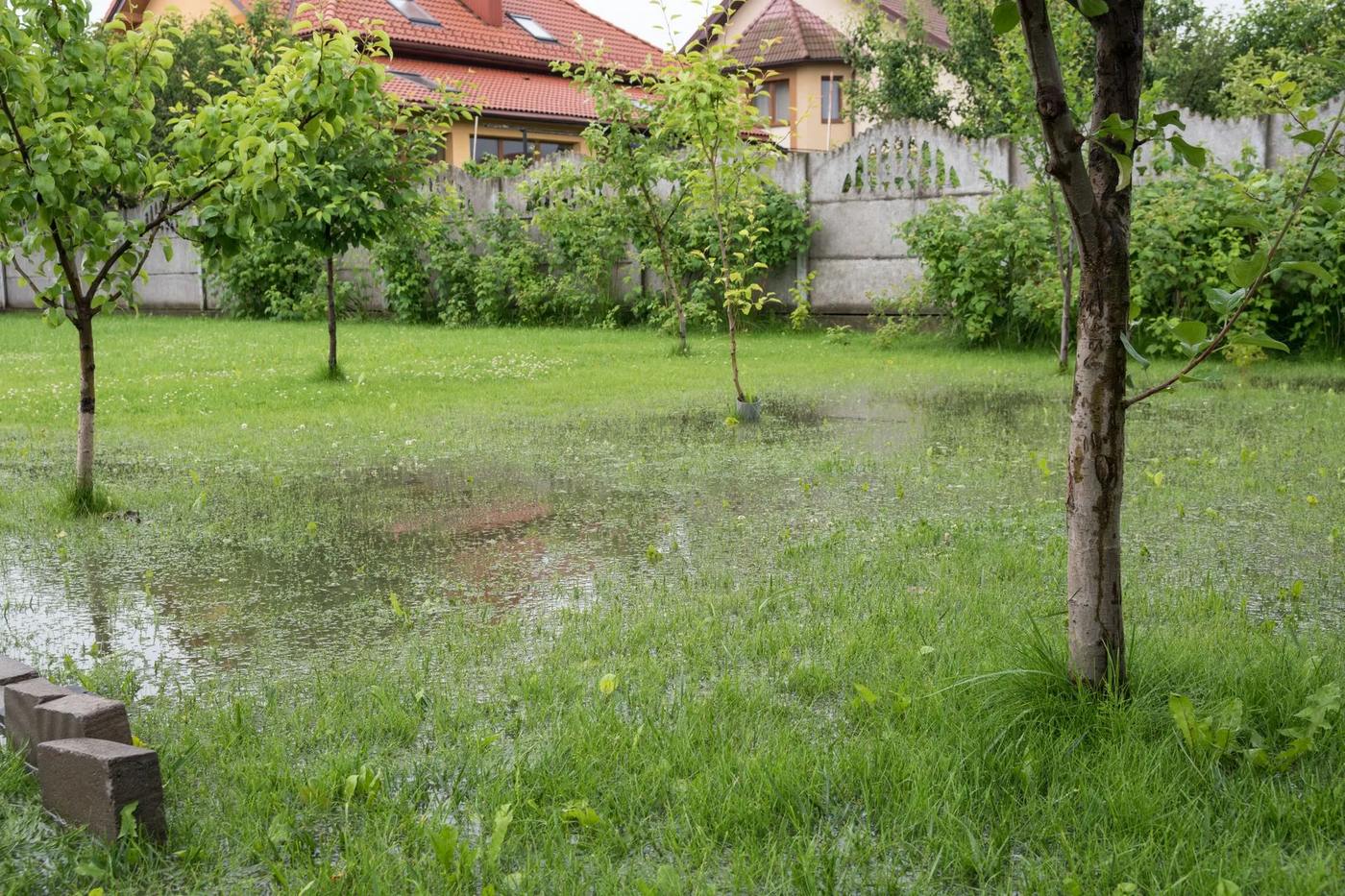
Drain fields in North Georgia face seasonal stress during the spring wet period that fields in sandier soil regions do not encounter. When the water table rises and clay soil is already absorbing sustained rainfall, the field's absorption capacity drops. Wet ground above the drain field lines after a significant March rain event that firms up within three to five dry days is a system functioning within its design limits for these conditions.
Ground that stays soft and wet above the field during a full week of dry weather, while the surrounding yard is completely firm, is a different situation. The field is not recovering between inputs, and that warrants professional evaluation to determine whether the system is temporarily stressed or structurally compromised.
The distinction matters because the responses are completely different. One calls for monitoring and possibly reducing household water load temporarily. The other calls for excavation and field repair or replacement.
System Overloading
Every septic system is designed for a daily wastewater volume based on the bedroom count of the home. When actual use substantially and chronically exceeds that volume, the drain field cannot process effluent as fast as it receives it.
The version of this problem that consistently catches homeowners off guard is a leaking fixture rather than a large household. A toilet flapper that fails to seat properly can introduce several hundred gallons per day into the system with no obvious external evidence. That chronic low-level input accumulates into persistent drain field stress that shows up as recurring soft spots or gradual drain slowing across the house. Fix the leaking fixture first. Then evaluate whether the system needs attention for the stress it absorbed.
Frequently Asked Questions
What is the most common cause of septic system failure in North Georgia?
Two causes account for the majority of failures in this market: drain fields that were undersized for actual clay soil permeability at installation, and tanks not pumped on schedule, allowing solids to escape into the drain field. Both are entirely preventable through proper installation engineering and routine maintenance.
How do I know if my situation is an emergency?
Sewage backing up into the house through drains or toilets is an emergency requiring same-day service. Sewage surfacing in the yard in volume is an emergency and may require notification of your county environmental health department. Slow drains, yard odors, and soft ground over the drain field are urgent but allow scheduling a professional evaluation within a few days.
Should I try to diagnose the problem myself?
Your observations are genuinely useful. Describe exactly what you are seeing and when it appears. But identifying the location and cause of a restriction or failure requires accessing the tank and in many cases running a camera through the line. Guessing the cause and treating the wrong thing delays the correct repair while the actual problem continues.
Get an Honest Assessment of Your System
Septic & Sewer Solutions evaluates the root cause before recommending any repair. We do not sell repairs you do not need. If your system is showing warning signs anywhere in North Georgia, contact us for a system evaluation and we will tell you exactly what we find.