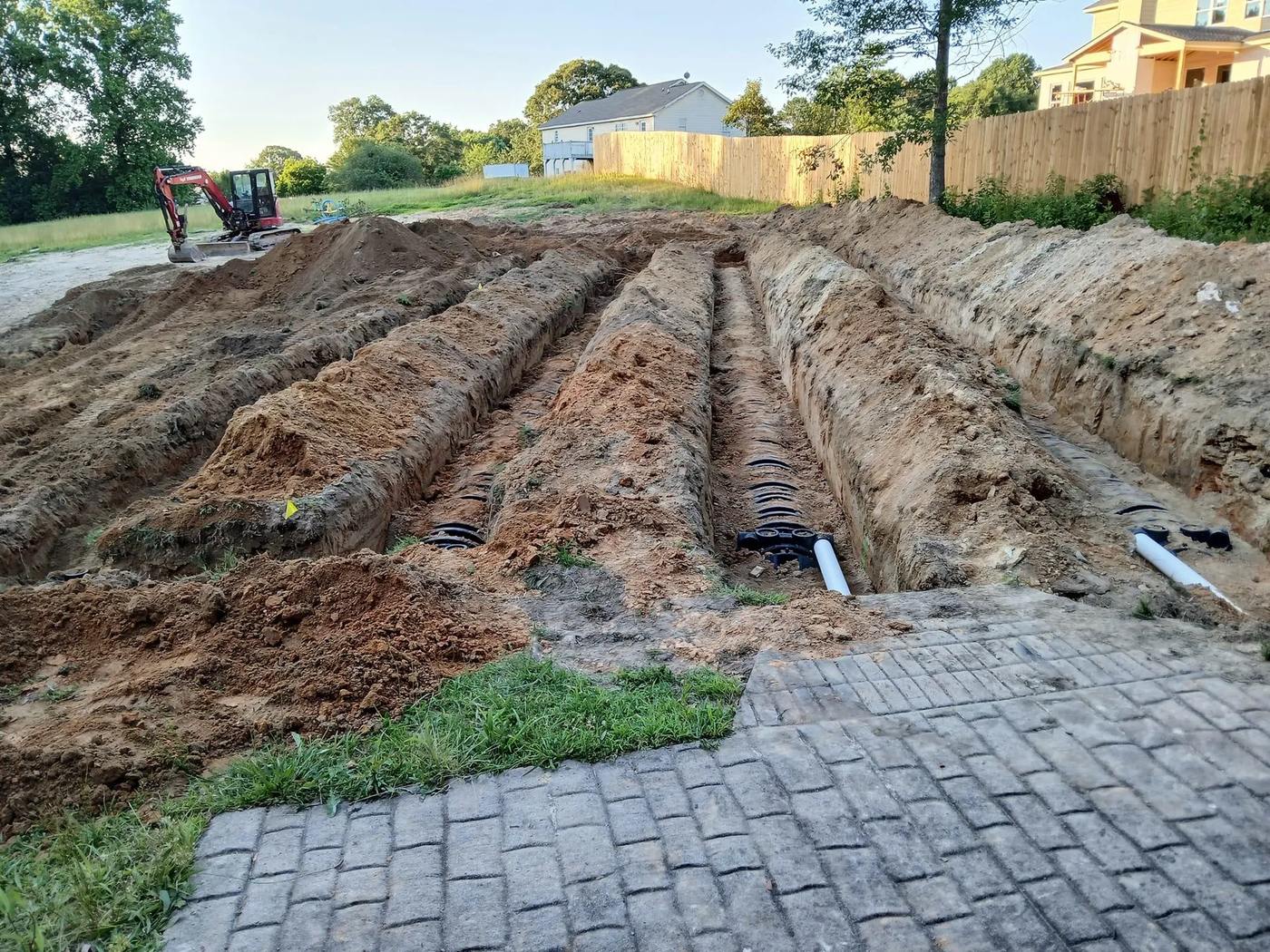
The septic tank is the part of the system people think about. It gets pumped. It gets inspected. Contractors talk about it. But the drain field is where wastewater treatment actually happens, and it is the component that costs the most to replace when it fails.
When wastewater leaves your home it flows into the septic tank, where solids settle to the bottom as sludge and grease floats to the top as scum. The liquid layer between them, called effluent, is what moves forward. When new wastewater enters the tank, that effluent is pushed out through the outlet and into the distribution system that feeds the drain field. The drain field itself is a network of perforated pipes laid in gravel-filled trenches below grade. Effluent seeps out of the pipes into the surrounding gravel, then downward into the native soil beneath the trench, where naturally occurring bacteria complete the treatment process before the water reaches the groundwater table.
The drain field is not a mechanical filter. It is a living biological system, and that distinction matters enormously when you are trying to understand why fields fail.
The North Georgia Wet Season Problem
From March through May, North Georgia receives the heaviest sustained rainfall of the year. Clay soil becomes progressively saturated through that period, and a saturated drain field cannot accept effluent at its normal rate. The math is simple. The field is still receiving the household's daily wastewater volume, but the soil's capacity to absorb it has dropped.
A field that shows wet ground above the lines during a heavy April rain event and recovers to firm within a few dry days is stressed but functional. That is the system working within its design limits for these conditions. What is different, and concerning, is wet ground that persists through dry weather. Soft soil above the drain field lines five days into a dry stretch, when the surrounding yard is completely firm, means the field is not recovering between inputs and needs to be evaluated.
Six Things That Destroy Drain Fields
Drain field failure in North Georgia traces back to a predictable set of causes. Understanding them is the foundation of protecting your system.
- Soil compaction from vehicles or heavy equipment crossing the drain field area. Clay soil that already has limited natural drainage loses what permeability it has when compressed. The damage is permanent.
- Skipping tank pumping on schedule. When sludge accumulates past the outlet baffle level, solids escape into the field with the effluent. Once solids contaminate drain field soil, the biological treatment capacity of that section is gone.
- Biomat accumulation advancing faster than the soil can process it. Biomat, a layer of organic material at the soil interface below the gravel, forms naturally over the system's life. It becomes a failure mode when the system is chronically overloaded or the tank has gone too long without service.
- Root intrusion from trees or large shrubs near the drain field. Roots pursue the moisture in drain field trenches, enter through pipe perforations and joints, and create blockages that disrupt normal distribution.
- Excessive water input from leaking fixtures or consistently high household use. Every gallon entering the system must be processed by the drain field. A running toilet can add several hundred gallons per day with no visible evidence until the field shows stress.
- Flushable wipes and grease entering the tank. Neither breaks down on the timeline that biological treatment requires. Both accelerate sludge buildup and shorten the effective interval before solids begin escaping into the field.
The common thread across all six is that none of them announce themselves quickly. They develop over months and become visible as system problems only after significant damage has already occurred.
Reading What Your Yard Is Telling You
Your drain field communicates its condition through the ground and grass above it, if you know what to look for.
Consistently soft or wet ground directly above the drain field lines on dry weather days means effluent is surfacing. It is a health hazard and it typically reflects a condition that has been developing longer than the visible symptom suggests. Unusually dark green grass growing faster in a defined strip over the field lines, distinct from the surrounding lawn, means nutrient-rich effluent is reaching plant roots closer to the surface than treatment requires. A sewage odor in the yard near the field that persists through dry weather indicates surfacing effluent producing gas.
Any of these observations warrants a call before the condition advances further.
Frequently Asked Questions
How long should a drain field last in North Georgia?
A properly designed and maintained drain field should last 25 to 35 years. Fields installed without adequate sizing for clay soil permeability, or those that received solid contamination from an unpumped tank, commonly fail within 10 years. Pumping the tank every three to five years is the single most effective action a homeowner takes to protect the drain field.
Can a failing drain field be repaired or does it need replacement?
It depends entirely on the failure mode. Biomat caught early may respond to resting the field. Root intrusion discovered before structural pipe damage can be cleared mechanically. Soil compacted by vehicle traffic or contaminated by solids from a neglected tank is structurally compromised and typically requires replacement of the affected sections. A proper diagnosis distinguishes between these situations.
What should I plant over my drain field?
Shallow-rooted grass is the appropriate cover for a drain field in North Georgia. Bermuda, zoysia, or fescue depending on sun exposure. No trees, no shrubs, no vegetable gardens. Vegetable gardens create a health risk from wastewater contact regardless of system performance. Trees develop root systems that eventually reach and damage the infrastructure. Grass holds the soil, absorbs surface moisture, and leaves the field undisturbed.
Let Us Take a Look Before It Gets Worse
If you are seeing any warning signs on your property anywhere in North Georgia, Septic & Sewer Solutions can evaluate the system and tell you honestly what you are dealing with. A repairable condition caught now is a fraction of the cost of a replacement project discovered later. Schedule a system evaluation today.